
Stop Automating Email. Start Automating Memory

Stop automating email. Start automating memory.
Everyone gets the framing wrong from the first conversation. They say things like, “I need to automate my follow-ups,” or “I want a sequence that goes out to leads.” The unit of work they’re picturing is the message. And once that’s the frame, every decision that follows is about the message. The cadence. The wording. The subject line. The trigger.
That framing leads to bad workflows, even when the messages themselves are fine. Because the actual problem in most small businesses isn’t that the right email didn’t get sent. It’s that the business owner forgot something important about a customer. The birthday. The follow-up after a hard appointment. The check-in two weeks after the consultation. The reminder about the document the client said they’d send. The owner remembered some of these things. They missed others. The miss is what cost the relationship.
If you’re a small business owner, your real bottleneck isn’t writing capacity. It’s memory. You don’t have enough RAM to hold every promise, every personal detail, every “I’ll get back to you next month” floating around your business. Nobody does. The clients you lose, you lose to the clients who get your attention more reliably.
What good automation actually does is offload memory. The system remembers when something happened, who was involved, what context surrounded it, and surfaces that at the right moment so a human can act. The message that gets sent at the end of that chain is a side effect, not the point. The point is that you didn’t forget.
Once you start thinking about it this way, the design of the workflow changes. You stop optimising for “did the email send” and start optimising for “did the right thing get noticed in time to do something about it.” Those are different success metrics. The first one is fully automated and forgettable. The second one requires the system to flag things to a human and let the human decide.
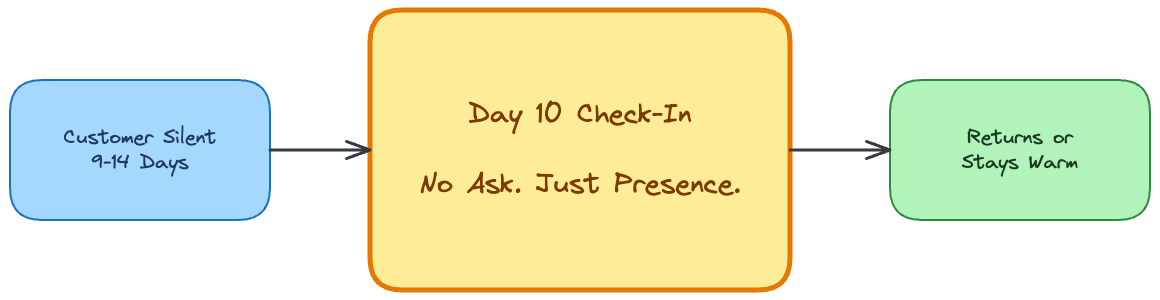
A retention reminder for a hairdresser shouldn’t be “send a rebook SMS at week 6.” It should be “if a client who normally comes every 6 weeks hasn’t booked by week 7, surface them to the owner with a one-line note about what they had done last time, and let the owner write a quick text in their own voice.” The output looks similar from the outside. The thing being automated is completely different.
The conventional view has a point. For high-volume, low-relationship businesses, fully automating the message is fine. An e-commerce store with 10,000 customers can’t have a human in the loop for every birthday email. The automated message is the only way it scales. But for the typical small service business with hundreds, not thousands, of customers, fully automating the message is the wrong target. There aren’t enough customers to justify the cold tone, and there are too many for human memory alone. Memory automation is the middle path that fits.
The reason this reframe matters is that most small business owners look at automation and decide it’s not for them, because they’ve seen what fully automated outreach looks like and they don’t want to do that to their clients. They’re right to be hesitant. What they don’t realise is that they’re allowed to use the same tools to do a completely different thing. They can use Claude and a CRM and Zapier not to send messages, but to remember on their behalf. To flag the client who’s been quiet. To pull the loan details before a renewal conversation. To draft a message that the owner reviews in 30 seconds and sends with their own thumb.
That’s a fundamentally different relationship to the technology. It’s not “the bot does the work.” It’s “the bot keeps the threads alive so I can do the work.” Which is closer to what small business owners actually want, and almost never what they get sold.
So when you’re scoping an automation project, the first question isn’t “what should we send.” It’s “what are you forgetting that you don’t want to forget anymore.” Start there and the rest of the design becomes obvious.
What looks like automation, in the businesses that get it right, is mostly just memory that doesn’t fail. The sending is incidental.